
Timeline of San José Public Library History
1800s
- 1872, Jul. 12 - San José Library Association begins a membership library in an upstairs room of the Knox Block (corner of First and Santa Clara streets); Collection built from donations
- 1880, May 1 - Library supporters persuade City Council to pass a resolution creating a tax-supported library system
- 1880 - Library located on south side of Santa Clara Street (between Market and First), William Redding becomes first City Librarian (1880-1887)
- 1889, May - Library moves to second floor of new City Hall
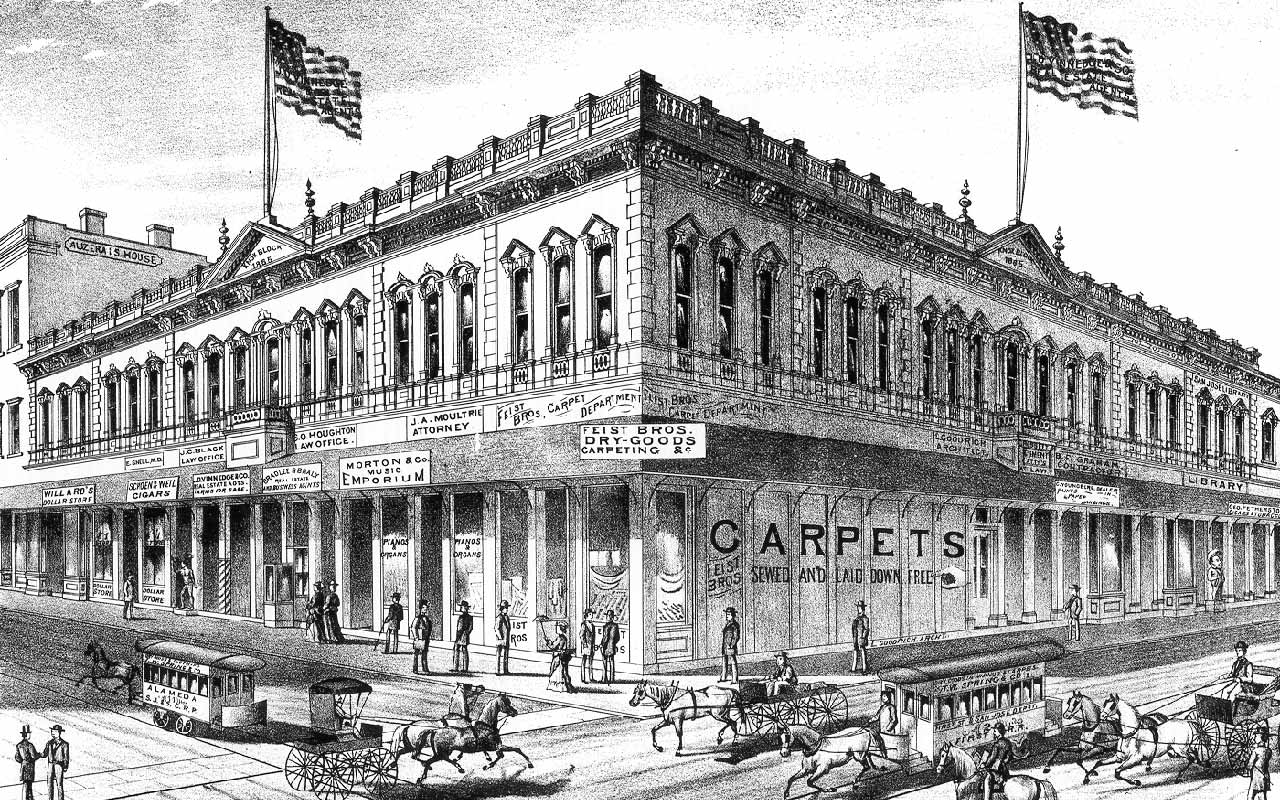
artwork of the Knox Block that housed the first San José library in 1872
1900-1959
- 1901 - Andrew Carnegie gives the City $50,000 for a new library building
- 1903 - Library moves to the new Carnegie Library at Fourth & San Fernando (future site of the King Library)
- 1907 - Carnegie Library constructed on East Santa Clara St. (the future "East San José Carnegie Branch")
- 1911 - First branch, East San José Carnegie, acquired when San José annexes the City of East San José
- 1937, July - Main Library moves from Carnegie location to the old Post Office building on the corner of Market and San Fernando streets (currently the San José Museum of Art)
- 1937 - San José annexes the town of Willow Glen, acquiring the Willow Glen Branch
- 1949 - Willow Glen Branch moves to current location on Minnesota Ave.
- 1959 - Bookmobile service begins with 60 stops every two weeks
1960s
- 1960 - Rosegarden Branch opens
- 1961 - Cambrian Branch opens
- 1964, Mar. 8 - West Valley Branch opens
- 1965 - A federal grant, along with a bond issue from 1961, provide $4,470,000 for construction of a new Main Library building
- 1965, Aug. - Hillview Branch opens
- 1966 - Calabazas Branch opens
- 1967 - Seventrees Branch opens
- 1968 - Berryessa Branch opens
- 1968 - San José annexes city of Alviso; Its City Hall (built 1934) becomes the Alviso Branch
1970s
- 1970, Apr. - Main Library opens on W. San Carlos St.
- 1971 - Almaden and Edenvale (December) branches open
- 1974 - Willow Glen Branch damaged in fire
- 1974 - Edenvale Branch renamed "Pearl Avenue Branch"
- 1975, Apr. - Rebuilt Willow Glen Branch opens
- 1976, Mar. - Evergreen Branch opens
- 1976, Apr. - Biblioteca Latinoamericana becomes affiliated with San José Public Library and opens in a facility provided by Sacred Heart Church as a result of a grant from the California State Library
- 1976, Dec. - Educational Park Branch opens in partnership with East Side Union High School District
- 1976 - Dewey Decimal System arrangement of collection adopted
- 1977, Fall - Empire Branch Library opens
- 1978, Dec. - Biblioteca Latinoamericana moves to a new facility in the former Woodrow Wilson, Jr. High School cafeteria
1980s
- 1983 - Flood destroys Alviso Branch collections
- 1984, Mar. - Alviso Branch reopens
- 1984, Nov. - Santa Teresa Branch opens
1990s
- 1990, Jan. 15 - Main Library rededicated as the "Dr. Martin Luther King, Jr. Main Library"
- 1993 - City grapples with issue of the Main Library being at 100% capacity
- 1994, Nov. - Voters approve formation of the Library Benefit Assessment District
- 1997, Feb. - SJSU President Robert Caret and Mayor Susan Hammer announced intent to collaborate and build a new library that will serve both communities
- 1998, May - Memorandum of Understanding between the City and University approved
- 1998, Dec. - Separate Operating and Development agreements approved by the City and University
Download the Operating Agreement (183K PDF, Adobe Acrobat Reader required)
- 1999, Mar. - Architectural design drawings completed for the new King Library
- 1999, Sep. - Expanded Alviso Branch opens
- 1999, Nov. 20 - Biblioteca Latinoamericana Branch moves to its current location on South First St.
- 1999, Dec. - Construction documents completed for the new King Library
2000s
- 2000, Jul.? - Construction begins on the new King Library
- 2000, Oct. 20? - Groundbreaking for the new King Library
- 2000, Nov. - Voters approve Branch Library Bond Measure providing $212 million for 6 new and 14 expanded branches
- 2001, Sep. - Empire Branch renamed "Joyce Ellington"
- 2003 - Expanded West Valley Branch opens
- 2003, Aug. - The new Dr. Martin Luther King, Jr. Library opens at Fourth & San Fernando
- 2004, Jan. 17 - Vineland Branch opens, the first of 6 new facilities funded by the 2000 Branch Library Bond Measure
- 2005, Jan. 22 - Tully Community Branch opens
- 2005, Mar. 12 - Expanded Berryessa Branch opens at its current location
- 2005, Jul. 9 - Dr. Roberto Cruz – Alum Rock Branch opens, replacing the county-operated facility from 1978
- 2006, Feb. 11 - Expanded Rose Garden Branch opens
- 2006, May 13 - Expanded Almaden Branch and Community center open
- 2006, Sep. 16 - Expanded Evergreen Branch opens
- 2006, Nov. 18 - Expanded Cambrian Branch opens
- 2007, Jan. 20 - Expanded Hillview Branch opens in its new location
- 2007, Nov. 3 - Edenvale Branch Library opens
- 2008, Jun. 28 - Expanded Joyce Ellington Branch opens
- 2008, Aug. 9 - Expanded Pearl Avenue Branch opens
- 2008, Aug. 23 - Expanded Willow Glen Branch opens
- 2009, Aug. 29 - Expanded East San José Carnegie Branch opens
2010s
- 2010, Feb. 6 - Expanded Santa Teresa Branch opens
- 2013, Jan. 26 - Expanded Seven Trees Branch opens
- 2013, Feb. 23 - Bascom Branch opens
- 2013, May 18 - Expanded Educational Park Branch opens
- 2013, Jun. 8 - Expanded Calabazas Branch opens
- 2016, Apr. 16 - Village Square Branch opens
- 2019, Apr. 8 - Mt. Pleasant Branch opens
